
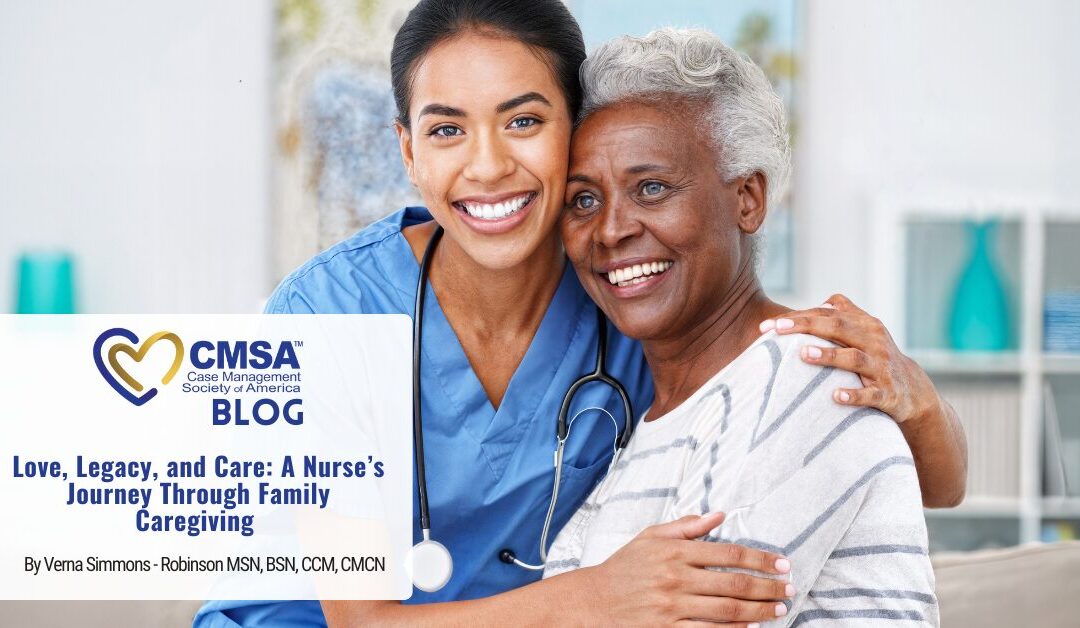
By Verna Simmons Robinson MSN, BSN, CCM, CMCN
Roots of Caregiving
Caring for others has always been part of who I am. Years before I wore a white nursing uniform, hard-bottom white shoes, and that nursing hat, I was quietly prepared for a life of caregiving through family traditions and everyday lessons.
As the first grandchild, I spent a lot of time with my grandparents and elders, soaking up their stories about love, responsibility, and the meaning of taking care of one another. They made sure I understood that taking care of family, especially our elders, wasn’t optional. It was what we did. Back then, I didn’t realize they were shaping me for a lifetime of caregiving. I just knew I loved being around them: their laughter, good food, and the warmth gave me a sense of safety.
Lessons Imparted by My Elders
Growing up, the stories and experiences shared by my elders were more than just stories from the past—they were powerful lessons that shaped my understanding of love and responsibility. Each life moment they shared emphasized the importance of caring for others, especially those within our family. Their guidance went beyond spoken advice; their actions consistently reinforced these values in our daily lives. It became clear to me early on that caring for family, particularly our elders, was not a decision to be made individually. It was a deeply rooted expectation, woven into the very fabric of our family’s traditions. This commitment to caregiving, passed down through generations, remains a core part of our family’s identity and continues to guide us in how we support and care for one another.
At the time, I did not fully grasp the extent to which these experiences were preparing me for a life devoted to caregiving. My appreciation lay in the moments spent with them: participating in their laughter, enjoying meals together, and experiencing the warmth present at every gathering. These formative moments established the groundwork for the caregiver and nurse I would ultimately become.
My grandmother, whom everyone called Mama, was a woman whose hug could make the world stop for a second; it was very calming. Her house always smelled of something cooking, and nobody ever went hungry, not even the neighbors. She cared for people in ways that went beyond words. There was an older person in the neighborhood who was alone and, many times, was disheveled and unclean. Mama would tell us to watch for him, ask him to go home, take a bath, bring his clothes back, and then she would wash and mend them. Watching her, I learned that care isn’t just physical; it’s about seeing people and making them feel like they matter. My first real test came when my sibling was in the hospital on a ventilator. For reasons I still can’t quite explain, my family turned to me to decide when to remove life support. I was young, but I was already considered the “medical” one. I spent hours by his bedside talking to him, hoping he could hear me. I told him I’d be okay and that I’d take care of our parents. In the end, I didn’t have to make that call because he passed on his own. That experience stayed with me. It was the first time I felt the weight of caregiving and understood that love sometimes means letting go.
Through the example of my loved one, I discovered that caregiving extends far beyond meeting physical needs. Proper care means recognizing each person's individuality and ensuring they feel valued and seen. This lesson became especially clear during a profoundly difficult chapter of my life.
Ultimately, I was spared the decision of removing life support, as my sibling passed away on his own. That experience left a lasting impact on me. It was the first time I truly understood the gravity of caregiving and learned that sometimes love means letting go.
Years later, Mama had a heart attack and a stroke in the small rural town where she lived. I can still remember that over-hour-long drive; it felt endless. Seeing her in that hospital bed, appearing helpless, so still and connected to machines, something broke in me. I was so sad. I immediately assessed her and slipped into nurse mode, frustrated by the limited care she was receiving and torn between being a professional and a granddaughter. Eventually, I arranged to transition her to Houston so we could take care of her. I showed my dad how to take family leave and taught him how to help with her care. He was embarrassed at first, seeing his mother so vulnerable, but he learned. We all did. Caring for her became a team effort that included feeding, bathing, managing her medications, and ensuring she felt loved and dignified. One day, as I was leaving her room, she lifted her head and said, “I love you.” Those were the last words she said. By the time I reached the door, got to my car, and drove off, she was gone. That moment broke my heart. She left me with one final lesson: love shows up until the very end.
Caregiving has been part of every chapter of my life. I’ve cared for my father, who was my best friend, and later for my mother and my mother's grandmother. Each time, I learned something new about resilience and grace. My family’s health history isn’t simple. It includes stroke, diabetes, cancer, heart failure, kidney disease, and hypertension. Coordinating between doctors, hospitals, and cities became second nature. It took patience, advocacy, and many prayers. Illness doesn’t just change the person who’s sick; it changes the whole family. I watched my father become his mother’s caretaker, and I helped him through that transition. I was a nurse, a teacher, and a daughter trying to hold everyone together. One of the most complex parts of caregiving is keeping your loved one safe while respecting their independence. My elders were very proud. They wanted to drive, cook, and make their own choices, even when it wasn’t always safe. Finding the balance between protecting them and honoring their wishes taught me that dignity is every bit as important as medication or treatment. When hospice entered the picture, it brought a new kind of challenge. In my family, hospice was misunderstood. They saw it as giving up and allowing the person to be killed instead of allowing them to die gracefully, and having those conversations required respect, love, prayers, and patience. I learned to focus on the quality of life, not the quantity of life. Learning to hear what the person who was ill wanted and to treasure all moments: quiet talks, memories, and just sitting together in silence.
My nursing career has taken me from acute care to chronic disease management and, finally, to case management, which has allowed me to work with the whole patient and their illness, no matter the setting. It reminds me of what my family taught me: to see the entire person, not just the diagnosis, and to advocate, coordinate, and care with skill and with heart. Every experience, both at work and at home, has shaped how I show up for others. Caregiving isn’t just something I do. It’s part of who I am. For me, being a caretaker was never a choice. It was a calling written into my family’s story. Every challenge and every goodbye have reminded me that caregiving is both love and labor, strength and surrender. Compassion isn’t just a professional skill; it’s an inheritance. The heart of nursing doesn’t begin in textbooks or hospital rooms.
The journey of caregiving begins within our homes, rooted in the important and meaningful act of caring for those who once cared for us. This sacred responsibility is not simply a chore or an obligation—it is a continuation of love and respect passed down through generations. By tending to our elders and family members, we honor the traditions and values they instilled in us, ensuring that their legacy of care endures within the fabric of our daily lives.
Renewing early means keeping your benefits and your budget in check. Renew today to lock in your lower pricing for 2 years. Don’t miss the chance to save!
Renew Your CMSA Membership Today: https://bit.ly/3Xg7YYQ
BIO: Verna Simmons Robinson MSN, BSN, CCM, CMCN holds both a Master of Science in Nursing (MSN) and a Bachelor of Science in Nursing (BSN) from UT El Paso. I graduated with honors and was recognized by Sigma Theta Tau (Sigma), a distinguished nursing honor society. I also completed my Associate's degree at Lamar State.
I am an active member of the CMSA Houston Gulf Coast Chapter, where I serve on the Board of Directors, focusing on Membership. Additionally, I serve on the Board of Directors for BNAGH, which focuses on Education.
With decades of experience as a nurse and caregiver, I have been defined by my commitment to service, volunteering, mentorship, education, and lifelong learning. My extensive background includes many years of experience in Nursing and case Management (CM) across various capacities.
She has also worked extensively in utilization review, auditing, coding, educator, prior authorization, and appeals. With extensive experience in case management and direct patient care, Ms. Robinson's career is defined by a steadfast dedication to service, mentorship, and education. Her approach to nursing and caregiving is deeply rooted in family tradition, emphasizing responsibility, advocacy, and the dignity of every individual. Ms. Robinson consistently ensures that each patient receives comprehensive, compassionate, and respectful care.
Verna what a great article, you are truly an inspiring example of caring and case management all wrapped up in one!! Kudos to you and your selfless caring to so many.
Verna, I’m so happy to be reconnected. It’s amazing how the very first sentence of this article immediately reminded me of your warm smile and eagerness to look out for anyone and everyone … whatever was needed. Nothing in this article surprises me about you. I’m sorry for your losses and ask that you have endured, but I’m also excited for what you’ve gained through all of it. What an awesome read!
Mrs. Verna your testimony is truly inspiring. It’s beautiful how you turned life experiences into purpose and healing for others. Thank you for the heart you bring to nursing — your journey shows exactly why you’re such an impactful nurse and case manager.
great article !
This is an exceptional article!!! 💫 Well done!!
Verna, this article is a beautifully written reflection on how caregiving is shaped by family, love, and tradition. The personal stories are heartfelt and powerful, showing the emotional strength needed to care for loved ones. It honors the legacy of those who taught us compassion and highlights caregiving as both a responsibility and a gift. I truly enjoyed reading this!!!!
Verna, thank you for sharing your journey!
This is an amazing reminder of just how important and necessary we are as a profession. Thanks for the reminder it’s not what we do it literally is who we are!!!
What an amazing gift you have shared with us, with tears running down my cheeks I say thank you!
Very well said, thank you for your compassion, love and heart of gold for caring for family and others in the time of need. It takes a special person to be a nurse and you nailed it.
Verna this was such a powerful message of who God created you to be. You have so honored your elders in the love and care of not just your family, but for all that He has entrusted in your care.
Your friend
Deborah Shannon Fedrick
Great Job, Verna. The thoughtful insight and how you incorporated family, caregiving and case management is exceptional. Thank you for sharing your journey. Much love!!