
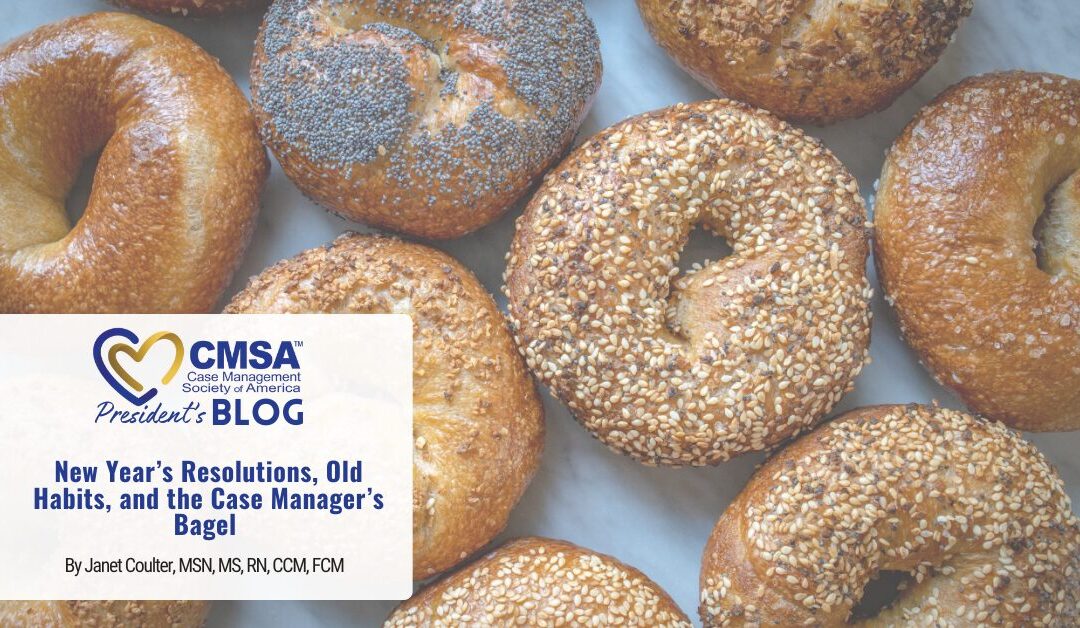
By Janet Coulter, MSN, MS, RN, CCM, FCM
Whether you’re fueling up for a morning huddle, powering through documentation, or taking a mindful pause between member calls, a good bagel has a way of meeting you exactly where you are. Some days are “plain,” some are a little “everything,” and some get a bit toasted. But like professional case managers, they show up anyway.
January often brings reflection, renewed goals, and New Year’s resolutions. New Year’s resolutions promise fresh starts, renewed energy, and positive change. Yet here we are. It’s February and for many, those resolutions may already feel distant or quietly abandoned. The good news? It’s not too late. In fact, this moment may be the perfect time to rethink how change really happens. New Year’s resolutions tend to rely heavily on motivation. Motivation is powerful, but it’s also fleeting especially in a profession as demanding as case management. When caseloads are high, documentation deadlines loom, and the emotional demands of our work intensity, willpower is often the first thing to go.
Habits, however, are different. They operate automatically, driven by cues and routines that conserve mental energy. True behavior change doesn’t come from wanting something badly enough. It comes from intentionally redesigning the routines that shape daily life. Many habits happen without conscious thought: checking emails late at night, skipping breaks, stress snacking between calls, or pushing through exhaustion instead of pausing. Awareness brings these patterns into focus. Once you identify the cue (stress, fatigue, boredom) you can interrupt the cycle. For example, if stress triggers mindless snacking or screen time, a healthier replacement might be a few deep breaths, a short walk, or a brief grounding pause. The goal isn’t perfection; it’s intentional choice. Trying to eliminate a habit without replacing it often backfires. The brain resists empty space. Sustainable change comes from pairing an old cue with a new, supportive routine. If late-night charting or email checking is hard to stop, consider creating a new wind-down ritual such as reading, journaling, or stretching to signal closure to the day.
Big resolutions can be inspiring, but small goals are what stick. Rather than committing to sweeping changes like “exercise every day” or “never work late,” try something more achievable:
- Move for 10 minutes each morning.
- Take one true break per shift.
- Log off at a consistent time twice a week.
Small wins build confidence, and confidence builds momentum especially in our profession where burnout is real.
Research shows habits take weeks or even months to form, and setbacks are part of the process. One missed day does not equal failure. What matters is returning to the routine without self-judgment. Compassion toward yourself and others is a skill case managers practice daily. It deserves to be practiced as self-care as well. Sharing goals, writing them down, or tracking progress makes intentions tangible. Accountability whether through a colleague, mentor, or personal reflection provides encouragement and perspective when motivation dips.
New Year’s resolutions aren’t about the calendar. They’re about alignment. Even if January is over, the opportunity to reset remains. Change doesn’t happen because a new year begins. It happens because you choose to show up differently, one small habit at a time.
Like that dependable bagel—plain, everything, or slightly toasted—progress doesn’t have to be perfect. It just has to be consistent.
Who says professional development can’t feel like a vacation? This year, CMSA is turning Las Vegas into a Case Manager’s paradise! Think of the 2026 CMSA Annual Conference & Expo as the perfect blend of high-stakes education and oasis-level networking.
And take advantage of the early bird registration rate while it lasts. https://bit.ly/4pQ3GE5
Bio: Janet Coulter, MSN, MS, RN, CCM, FCM is President of CMSA. She is a transplant case manager with a wide variety of experiences including educator, administrator, team leader, and Director of Case Management. Janet holds a Master of Science in Nursing from West Virginia University and a Master of Science in Adult Education from Marshall University. She has published many articles in CMSA Today and the Professional Case Management Journal and served as a reviewer for the Core Curriculum for Case Management Third Edition. She has served as President-Elect of CMSA, Chair of the CMSA Today Editorial Board, Chair of the Nominations Committee, and Vice-President of the CMSA Foundation board. Janet was the recipient of the CMSA National Award of Service Excellence and Southern Ohio Valley CMSA Case Management Leadership award and was recently inducted as a Case Management Fellow from CMSA.