
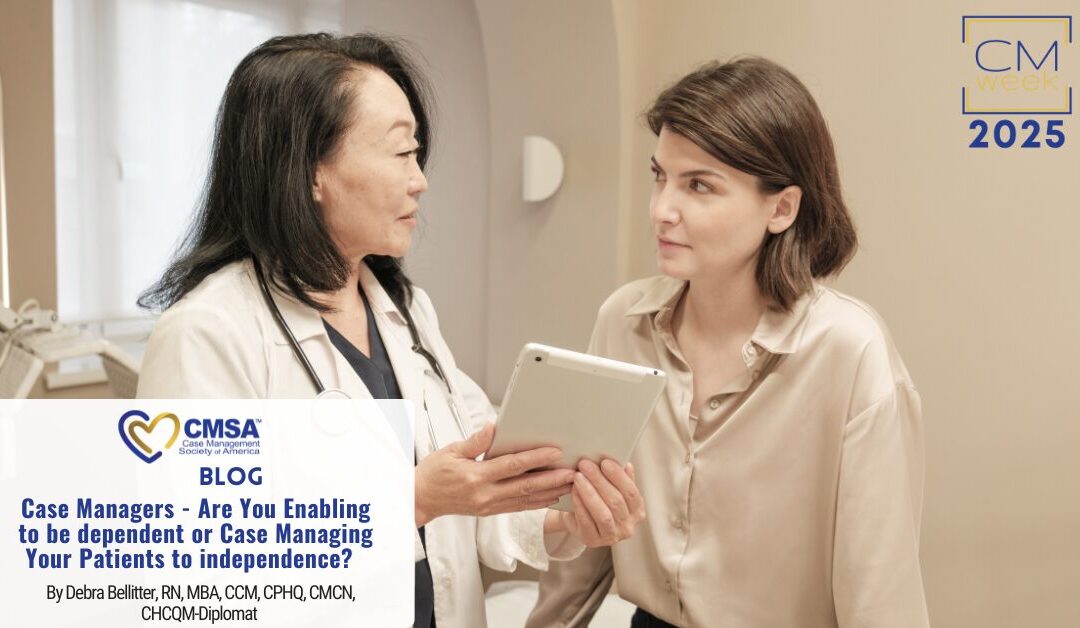
By Debra Bellitter, RN, MBA, CCM, CPHQ, CMCN, CHCQM-Diplomat
*Please note that patient, client, and beneficiary are used interchangeably.
Case management has become more critical than ever, but a fundamental question persists: are you truly enabling patients to become independent in their care, or are you simply managing them? In the busy workload of the day, it is sometimes easier to just “do it yourself” than to guide the patient. With each patient that comes across your desk, the needs and assistance they require will need to be individualized. This will come from your initial conversation and assessment of the patient and caregiver.
The distinction is significant. Managing patients focuses on meeting immediate needs and addressing urgent concerns. Enabling patients goes a step further by fostering long-term independence. When patients develop the skills and confidence to take an active role in their care, the result is improved health outcomes, decreased reliance on healthcare resources, and stronger, more collaborative relationships between patients and providers.
Managing Patients: Necessary but Limited
Traditional case management often centers around controlling processes for patients: arranging appointments, coordinating medications, ensuring follow-ups, and solving logistical barriers. While these activities are necessary, particularly for high-risk or vulnerable populations, they tend to foster dependency. Patients learn that someone else will always “fix” the problem, which leaves them less capable of handling challenges on their own. This builds dependency on you, the case manager. We must ask ourselves, is this really the best solution for the patient? Your assessment will tell you how competent the patient and caregiver are, versus their motivation to take ownership of their care.
Enabling Patients: The Path to Independence
Enabling shifts the focus from doing for patients to equipping them. It reframes case management as a partnership rather than a process. Case managers serve as coaches, mentors, and educators who help patients build the skills, knowledge, and confidence to manage their care. After the complete assessment of the patient and caregiver, the case manager can facilitate a patient-involvement plan that will provide success.
Key strategies to assess and utilize in the patient’s plan of care may include:
• Health literacy: Teach patients to understand their conditions, treatments, and warning signs. Ensure you are teaching at the level of their knowledge base. Ask questions to ensure understanding of the teaching, disease process, and medications, along with signs and symptoms of disease exacerbation.
• System navigation: Show patients how to schedule, advocate, and solve problems within the healthcare system. This is the most difficult for patients and caregivers. As we all know, healthcare navigation is not easy, even for some of us. Utilize aids for the patient, such as automatic medicine dispensers, calendars, or reminders on their cell phone.
• Digital empowerment: Encourage adoption of patient portals, telehealth platforms, and medication tracking apps. Do they understand technology, their provider apps, or how the system works? Some may be knowledgeable, while others may become frustrated, especially with the introduction of AI. The good part is that the baby boomers are our oldest population, and they are not very tech-savvy.
• Self-management goals: Align health goals with daily life, reinforcing small wins that build confidence. Celebrate the small things and work up to larger self-management goals.
This requires more upfront effort but assists individuals with independence. When patients are enabled, they demonstrate higher adherence, lower readmission rates, and greater satisfaction while requiring fewer intensive interventions.
A Balanced Approach
The reality is not either/or. Some patients will always need higher levels of direct management, particularly in acute or crisis scenarios. But every case manager should incorporate an enablement framework, assessing patients for readiness and intentionally progressing them toward independence. If it becomes realization the patient cannot acquire independence, the support system is vital. Not only one that is there for the patient, but willing and able to assist with the needs of the patient. When patients lack a reliable support system, it becomes essential to explore appropriate alternatives together. Options may range from arranging in-home assistance to considering placement in a nursing facility, depending on the individual’s needs and circumstances. The spectrum of possibilities is broad, and the case manager’s role is to help identify the most suitable solution that promotes safety, independence, and quality of life.
Case managers who prioritize patient independence are not only improving but also transforming the sustainability of their organizations. By enabling your patients, you shift case management from short-term problem-solving to long-term capacity building. Remember, each patient and caregiver situation is different. There is no single solution that will apply to every situation. Effective case management requires critical thinking, flexibility, and the ability to adapt your approach to the unique needs and circumstances of each patient.
The ultimate measure of success is not how well you manage patients, but how confidently patients can manage themselves.
Celebrate Case Managers during #CMWeek2025 - Find the full week of activities and discounts here: https://cmsa.org/about/national-cm-week/
Bio: Debra has been in healthcare for over 40 years, starting her career as a nurse at St. Joseph’s Hospital. She then progressed into many different areas of healthcare. These include management, managed care, and insurance. She has worked as a floor nurse, utilization and case management and quality management along with executive positions over the years. Her focus has and will always be the best patient care provided to our patients. She has been involved with multiple professional organizations in Case Management, sitting on National and Local Boards, Quality Management and Managed Care. Debra has spoken on a National and Local level along with being published. If you ask her, her greatest accomplishment in life if her daughter, who currently lives in Dallas
Such an insightful blog. It’s important for Case Managers to set their clients up for success for the times they won’t be there to help. In my work with children with medical complexity, the system navigation piece is fundamental for their caregivers’ success. Modeling and collaborating on how to schedule an appointment or access transportation can make all the difference.